Why Fast Field Spraying Is Changing How UK Farms Protect Crops
Speed matters more than ever in crop protection
There is a window in every growing season when a decision has to be made fast. Maybe it is a late blight forecast for potatoes, a grassweed flush in winter wheat, or an aphid build-up that could spread barley yellow dwarf virus. Waiting three or four days for a conventional sprayer to become available can mean the difference between a clean crop and a costly rescue job. That is why more growers across the UK are looking at fast field spraying as a practical option rather than a novelty.
The idea is simple: get the right product onto the crop at the right moment, without the logistics of moving a large ground rig, checking tramlines, and hoping the weather holds. Aerial application with drones has moved from experimental to operational, and the pace of that change has surprised a lot of people who remember when drones were just for taking photos of their fields.
What makes drone spraying genuinely fast
Speed in spraying is not just about how many litres a machine can carry. It is about the whole workflow. A ground sprayer has to travel from the farmyard, fill up, work the field, return for more product, and often refill several times a day. A drone, by contrast, can be set up at the field edge, fly a mapped route, and return to a designated refill point that might be a bowser or an IBC tote. The operator does not drive the sprayer; the drone does the driving, and the pilot stays in one place.
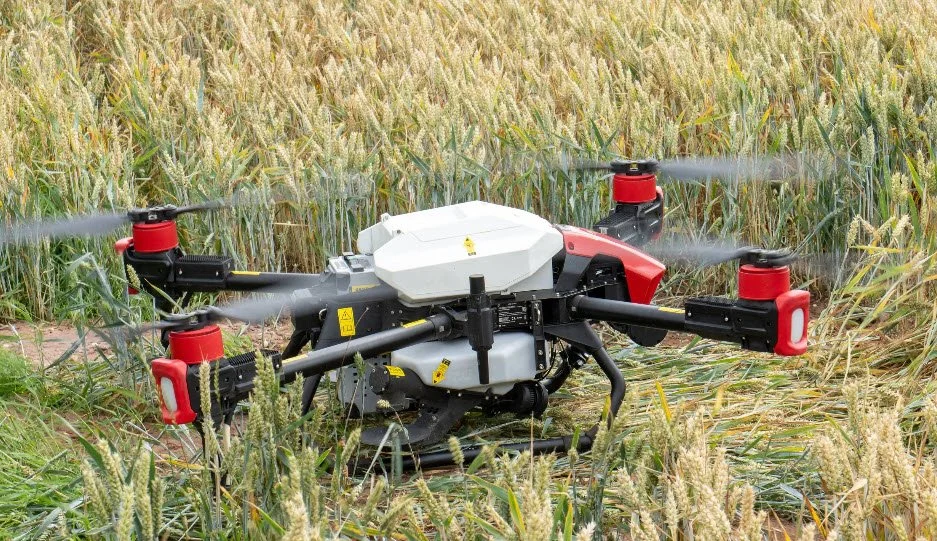
Modern agricultural drones like the DJI Agras T50 or the XAG P100 Pro can cover surprising areas in a single session. The limiting factor is battery life and tank size, but the turnaround time is short. Swapping a battery and refilling takes minutes, not the half hour you might spend washing out a ground rig and repositioning. That is where the real gain appears: not in one pass, but in the number of passes you can complete in a day.
There is also the question of field conditions. After heavy rain, a ground sprayer can cause compaction or get stuck. A drone does not touch the crop or the soil. So on days when a tractor would sink, a drone can still be working. That flexibility is a genuine advantage for fast field spraying, especially on heavy clay soils common across the Midlands and the South West.
Precision that goes beyond speed
Speed on its own is not enough. If you are covering ground quickly, you need to be sure the product is going where it should. That is where precision agriculture comes in. Drones are not just faster; they are more accurate at the point of application. With GPS guidance and field mapping, a drone can follow the exact contours of a field, avoid obstacles like telegraph poles and trees, and vary the rate of application according to a prescription map.
Variable rate application is not a new idea in farming, but drones make it easier to implement on smaller fields or awkward corners that a large sprayer might miss or overlap. Instead of applying a blanket rate, the drone reads the map and adjusts the flow from the nozzles in real time. This can reduce waste, lower the risk of crop damage from overdosing, and keep more of the product on target rather than drifting off.
Nozzle technology has also improved. The latest drone sprayers use rotary atomisers or hydraulic nozzles that produce a consistent droplet size. That matters because droplet size affects drift and coverage. Too fine, and the product can blow away; too coarse, and you might not get the coverage you need. The ability to match nozzle choice to the product and the weather is part of the craft. It is not just about flying fast; it is about flying smart.
What growers should consider before switching
There is no single answer for every farm. The first question is whether your fields are suitable. Drones work best on fields that are not huge, say up to 20 or 30 hectares, and where there are no major obstacles. They are also useful for late-season applications when the crop is too tall for a ground rig to travel through without damage. For example, in oilseed rape or tall cereals, a drone can fly over the canopy and apply a fungicide or a growth regulator without flattening the crop.
Another consideration is the product label. Not every agrochemical is approved for aerial application. You need to check the label for the specific product and the rate. Some products, especially those from major manufacturers like Bayer Crop Science, Syngenta, and BASF, have been tested for drone application and have label recommendations. Others have not. Working with a specialist who knows the regulations is essential.
There is also the question of cost. A drone spraying service is not necessarily cheaper per hectare than a ground sprayer, especially on large, open fields where a self-propelled sprayer can cover 40 hectares an hour. But when you factor in timeliness, reduced crop damage, and the ability to spray in conditions that would stop a ground rig, the economics can shift. For a farm with multiple small fields, or a livestock farm that also grows a bit of arable, the flexibility is often worth more than the raw cost per litre.
Regulation and safety: the part people forget
Flying a drone over crops is not the same as flying a toy in the garden. In the UK, the Civil Aviation Authority sets the rules. For commercial work, you need permission from the CAA, and that usually means holding a valid PfCO (Permission for Commercial Operations) or working under a company that does. There are also restrictions on flying beyond visual line of sight, though that is changing. For now, most drone spraying is done within visual line of sight, which means the pilot must keep the drone in view at all times.
That is not always easy on a large field. You might need spotters or a second operator to maintain line of sight. Some companies are testing beyond visual line of sight operations with the CAA, but it is still early days. In the meantime, a practical approach is to use drones on fields where you can see the whole working area from a single point, or to break the field into sections.
There is also the matter of stewardship. The National Farmers' Union has been supportive of drone technology, but it also urges growers to think about the environment and neighbours. Spray drift is a real concern, especially near watercourses or residential areas. Using the right nozzles, checking wind speed, and keeping a buffer zone are part of responsible operation. Fera Science, the government-backed research agency, has done work on drift and deposition, and their findings are useful for anyone planning aerial applications.
What the market looks like now
The drone spraying market in the UK is still small compared with Asia or the US, but it is growing. Companies like Hylio in the US have shown what is possible with high-capacity drones, and Yamaha Motor has been in the agricultural aviation business for decades with its R-MAX helicopter. In the UK, most growers will not buy a drone outright; they will hire a contractor. That makes sense because the technology changes quickly, and the regulatory burden is not something every farmer wants to take on.
When you book a drone spraying service, you should expect the operator to do a site visit, map the field, check for obstacles, and discuss the product and rate. They will also need to know about any nearby beehives or sensitive areas. A good operator will ask those questions. If they do not, find someone else.
Looking ahead: where fast field spraying is heading
The pace of change in drone technology is remarkable. Battery life is improving, payloads are getting bigger, and the software for route planning is becoming more intuitive. There are also developments in autonomous operation, where the drone can fly a pre-programmed route and return automatically, with the pilot only supervising. That will push fast field spraying even further, because it removes the human factor from the flying and lets the operator focus on logistics and quality control.
There is also the possibility of using drones for more than just spraying. Seed broadcasting is an obvious extension. Some contractors already offer direct seeding of cover crops or grass into standing maize or stubble. The same platform that sprays can spread seed, and the same principles of accuracy apply.
For the grower, the message is not that drones will replace all ground spraying. They will not. But they are another tool in the box, and for those moments when speed is critical, they are hard to beat. Whether it is a sudden disease outbreak or a narrow weather window, having the option to call in a drone operator can save a crop. And as the technology matures and the regulations evolve, that option will only become more accessible.
If you are thinking about fast field spraying for your farm, start with a conversation. Talk to your agronomist, check the product labels, and ask a local drone contractor about their experience. The best approach is to trial it on a field that is awkward or time-sensitive, and compare the results with your usual method. You might be surprised by what a difference a few hours can make.